Yes, according to the San Francisco Gate, Apple will be closing down Lala for good on May 31st. The decision for many has come unexpectedly, and Apple has the blogsphere questioning their decision to close Lala. Was it because Lala wasn’t generating enough revenue? Was Lala losing customers? Well the San Francisco Gate believes Apple is getting ready to unleash their version of the cloud, but it’s still speculation. It will be a shame if Apple doesn’t make use of the cloud distribution technology Lala has, and incorporates it into iTunes somehow. The only downside I see to Lala closing is that all the users who were loyal to the service will be left without a home. This also makes me wonder what will Pitchfork be using as an alternative source to stream music come May 31st? The “Apple Cloud” saga begins (maybe).
Submitted by: Jarvis R. Smith
Source
http://www.sfgate.com/cgi-bin/article.cgi?f=/g/a/2010/05/01/bloomberg1376-L1RCTK1A74E9-5.DTL
Showing posts with label technology. Show all posts
Showing posts with label technology. Show all posts
Saturday, May 1, 2010

Saturday, April 24, 2010
Cloud Computing (Reality or Fiction)?
I came across an interesting article on Yahoo!’s Associated Press speaking about the cloud and how many companies like Rhapsody have been using it for streaming music over the internet and on mobile devices. Associated Press gave some insight on why the cloud is beneficial for some music listeners, especially the ones who have a wide variety of musical tastes, and consume new music daily. At the same time they focused on why the cloud hasn’t crossed over to the mainstream. One point AP makes is that the cloud hasn’t been marketed well enough to the masses to make them understand why it’s better than buying music in stores or online. Also, many consumers do not like the idea of having to pay a monthly bill for music. Along with these issues for the consumers, record labels are hesitant of moving to the cloud because it hasn’t proven itself as being a strong way to generate revenue from music streams.
I think the cloud is still something that needs to be developed. I’ve been researching this for the past few months, and it sounds like a great concept expect there are a lot of issues on the legal side that stand it its way (read this article). So, I can understand why many labels are wary of joining. Given more time, I think the cloud could be the thing that reinvents record labels, and make them work within the digital era of music.
Submitted by: Jarvis R. Smith
Source
http://news.yahoo.com/s/ap/20100419/ap_en_mu/us_music_in_the_cloud
I think the cloud is still something that needs to be developed. I’ve been researching this for the past few months, and it sounds like a great concept expect there are a lot of issues on the legal side that stand it its way (read this article). So, I can understand why many labels are wary of joining. Given more time, I think the cloud could be the thing that reinvents record labels, and make them work within the digital era of music.
Submitted by: Jarvis R. Smith
Source
http://news.yahoo.com/s/ap/20100419/ap_en_mu/us_music_in_the_cloud
Saturday, April 10, 2010
DRM (IT’S ALIVE!)
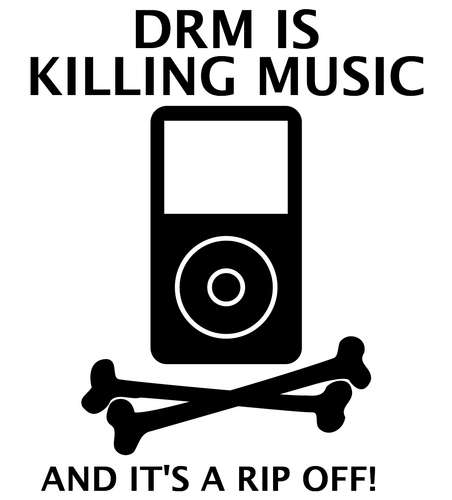 D.R.M., three letters that caused controversy within the music industry, and made many record labels become public enemy number one in the eyes of consumers who were legally buying music online. What DRM (Digital Rights Management) was; was a access control software that enabled copyright holders to put restrictions on how many times a user could copy, transfer, and reproduce an MP3 file on another device. Consumers weren’t happy with these restrictions, and once DRM began to give consumer's computers viruses (due to the faulty technology) they were fed up with record labels BS, and wanted this technology gone.
In the end, labels eventually got rid of DRM, but according to a recent article in TechCrunch record labels have found a new way to watermark MP3’s without people noticing. The new “Dirty MP3’s” now collect information about the buyer and the music transactions they’ve made. According to an anonymous source TechCrunch spoke with, this is how it works:
“During the buying process a username and transaction ID are known by the online retailers. Before making the song available for download their software embeds into the file either an account name or a transaction number or both. Once downloaded, the file has squirreled away this personal information in a manner where you can’t easily see it, but if someone knows where to look they can. This information doesn’t affect the audio fidelity, but it does permanently attach to the file data which can be used to trace back to the original purchaser which could be used at a later date.”
If that doesn’t rile you up then here’s the real kicker. According to the anonymous source Apple and Wal-Mart are alleged to be using this watermark on their MP3’s.
What does this mean for all of us? Well if Apple and other online retailers succeed in creating “The Cloud” then we might have another DRM situation on our hands. It’s alleged by the anonymous source that record labels will want this new watermark embedded on all the music streamed on the cloud. I hope this isn’t true, but if it is then DRM will be making it’s return in a major way. Yikes!
Submitted by: Jarvis R. Smith
Source
http://techcrunch.com/2010/04/06/how-dirty-mp3-files-are-a-back-door-into-cloud-drm/
Saturday, April 3, 2010
Don’t Sleep on Geolocation
A few posts ago I mentioned how SPIN magazine teamed up with Foursquare to host a musical scavenger hunt for SXSW . A recent post on Hypebot analyzed the use of Foursquare and other geolocation services during SXSW. The point they were making was how useful these geolocation services are in terms of attracting crowds to events. Also, for using it has as a tool to market your business or band to a larger audience.
I thought this was interesting because these services play an important role in tracking where your audience comes from. Also, these services offer new ways for bands to interact with their fans, and gives them an opportunity to host special contest using geolocation to get people involved with an event. Overall, these networks are still new to the social media market, but with more bands and businesses finding creative ways to use them. I’m sure we’ll see more innovative marketing strategies to come into play.
Submitted by: Jarvis R. Smith
Source
http://www.hypebot.com/hypebot/2010/04/geolocation-foursquare-gowalla-music-you.html
Saturday, March 6, 2010
SXSW gets a new SPIN with the help of Four-squares

I think this scavenger hunt is interesting because it’s a creative way for SPIN to gain more readers to their magazine. I have no doubt that one of those rewards will be a year subscription to their magazine, and few other products/events they’re sponsoring. Also, this is good for Foursquare because they could get more people to use their service after using it during SXSW. Overall, I think this type of fan engagement and partnership between companies needs to occur more often because it provides new ways to enhance the way music can be marketed via mobile phones. I can only imagine how this type of interactivity would work for a band releasing an album.
Submitted by: Jarvis R. Smith
Source
http://mashable.com/2010/03/06/spin-magazine-foursquare/?utm_source=feedburner&utm_medium=feed&utm_campaign=Feed%3A+Mashable+%28Mashable%29
Saturday, January 30, 2010
Music Now Has DNA
The creators of the MP3 (Bach Technology) are ready to once again change the way consumers obtain and experience music as they plan to create a successor to the MP3 with “MusicDNA”. The unveiling of this new technology was announced at MIDEM, a major music business trade show that addresses key issues and trends that are affecting all aspects of the music industry. According to Bach Technology’s CEO Stefan Kohlmeyer: “The MP3 was great for its time, but it did not support multimedia”, and now with MusicDNA they are able to do that by adding: lyrics, artwork, tour dates, merchandise, videos, and twitter feeds into this new format. Another good thing about MusicDNA is that it serves as a competitor towards illegal file-sharing because you can only receive this extra content if you obtain a legitimate format of MusicDNA.
I personally think this is a good idea because it gives record labels an innovative way to market music to consumers over the internet. They now have a stronger reason to entice consumers to buy music by making certain content (unreleased songs, ringtones, etc.) only available if you buy the MusicDNA format. I find this technology similar to the downloadable content game developers offer consumers through gaming platforms like Microsoft’s Xbox 360 and Sony’s Playstation 3, which adds extra content to a videogame for more hours of game play. MusicDNA will do the same thing as they keep consumers intrigued in a song or album longer than a few months as extra content becomes available with each update.
The only bad thing I see is that it may cost more to buy this format than the original MP3. I think this format would most definitely spike up prices for entire albums, and consumers may find themselves spending $15-18 dollars (again) for albums. Only time will tell where Bach Technology will go from here, but if all goes well with their beta testing phase we can expect to see MusicDNA hit the digital-sphere by this summer.
Submitted by: Jarvis R. Smith
Sources
1. Music Week
http://www.musicweek.com/story.asp?sectioncode=1&storycode=1039771&c=1
2. RollingStone
http://www.rollingstone.com/rockdaily/index.php/2010/01/25/mp3-creators-unveil-new-music-file-format-musicdna/
MusicDNA Website
http://www.musicdna.info/
I personally think this is a good idea because it gives record labels an innovative way to market music to consumers over the internet. They now have a stronger reason to entice consumers to buy music by making certain content (unreleased songs, ringtones, etc.) only available if you buy the MusicDNA format. I find this technology similar to the downloadable content game developers offer consumers through gaming platforms like Microsoft’s Xbox 360 and Sony’s Playstation 3, which adds extra content to a videogame for more hours of game play. MusicDNA will do the same thing as they keep consumers intrigued in a song or album longer than a few months as extra content becomes available with each update.
The only bad thing I see is that it may cost more to buy this format than the original MP3. I think this format would most definitely spike up prices for entire albums, and consumers may find themselves spending $15-18 dollars (again) for albums. Only time will tell where Bach Technology will go from here, but if all goes well with their beta testing phase we can expect to see MusicDNA hit the digital-sphere by this summer.
Submitted by: Jarvis R. Smith
Sources
1. Music Week
http://www.musicweek.com/story.asp?sectioncode=1&storycode=1039771&c=1
2. RollingStone
http://www.rollingstone.com/rockdaily/index.php/2010/01/25/mp3-creators-unveil-new-music-file-format-musicdna/
MusicDNA Website
http://www.musicdna.info/
Saturday, November 14, 2009
Shazam!
Shazam Encore recently debuted on the iPhone. Apparently, Shazam Encore is a music discovery application that allows people to "learn more about their music." It also allows people to find music that is similar to the music that they already like. This new version of Shazam features some improvements and new functionality. Shazam also can apparently detect what a song is if you put your iPhone or iPod touch close enough to the speakers. This means that it will tell you who the artist is, song name, etc...
With this new release, the app is being considered a premium program, meaning that you need to pay for it now. The free version of Shazam will still be useable and downloadable. However, new users of the free version are limited to five Tags per month.
This seems like a neat program, although I have yet to use it myself. It also helps in introducing people to new music and would lead to at least some increased sales. Apparently it features Twitter and Facebook integration of some sort, so I am sure that there is some additional marketing opportunity in that functionality.
- Derek Jenkins
Subscribe to:
Posts (Atom)