Monday, October 12, 2009

GLEE!

So recently a new TV show has come on the air called Glee. Glee mixes together a story line of a high school glee club with a musical feeling. Many didn't think this show would succeed, but not only are the ratings up, the songs themselves sell well on iTunes. Glee draws in 7.8 million viewers per week. I think it is key for artists featured on this show to see how possibly there record sales can increase by being associated with new hit show. Many artists also would gain greater exposure by allowing their songs to be featured on this show. The show has a great draw, and a variety of fans. I think this is the perfect opportunity for artists to mix TV with their music. The actors featured on the show also all have 36o deals with Columbia, and are creating buzz for themselves in the music industry as well. It will be interesting to see the next steps Glee will take after the first soundtrack release on Nov. 3. I can see a tour in the works already, with countless opportunities for merchandise.

http://www.billboard.biz/bbbiz/content_display/industry/e3i1c9f6a73741ca4f558a3e5b6c3c123b7

- Val South

Sunday, October 11, 2009

EMI music downloads & Myxer Mobile

Myxer just made a deal with EMI to add their digital music catalog to Myxer's mobile offering. This deal cover the US and Canada and makes EMI the first major label to be put on Myxer's platform. Myxer is mobile web based, which means we'll be seeing artist branded sites similar to I-phone apps. These features will be usable on most mobile phones and should have many possibilities with Myxer's customizable mobile web platform.
This was a brilliant move by both companies and should prove promising for marketing songs through EMI and artists as a brand. More and more we keep seeing a trend of the artist trying to sell more then just a song, but an experience. The artist is now using technology to become closer to the fan then they ever have before, to stay relevant and push other forms of money making deals. Cell phones are a direct advertising tool that stays with the potential customer all day long. This gives more marketing time and access to reach potential fans no matter where they are or possibly what they're doing.
I think well see a lot more mobile providers team up with music sites in the future. This is the future and the driving force behind it is web access, portability, and convenience. It's almost like before advertising would mostly reach people at home or in the car, but now we can be reached everywhere at almost all times. I'm excited to see what other applications or technology will be built in the future, to expand on what we already have.

By: Andre Rodriguez

Grooveshark: The Biggest iPod Ever


I haven't downloaded a new song in over two months. Though I previously to constantly download hundreds of tracks each month, a streaming website called Grooveshark has drastically changed my music downloading habits.

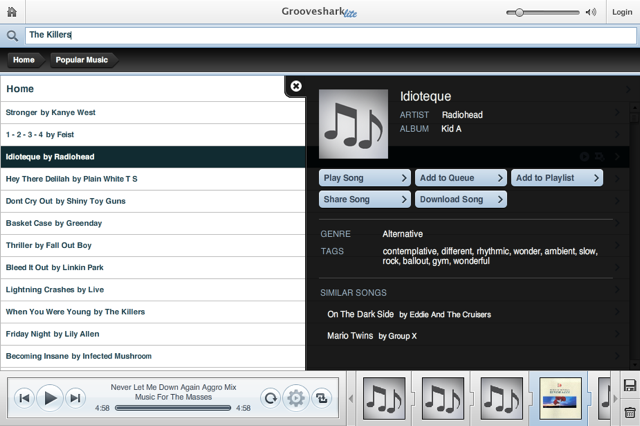
Grooveshark is a music search engine and streaming service that allows users to search, stream, and upload music for free. All music uploaded is available to the public, and users can create playlists that are available on the site. While their Autoplay feature is much like that of Pandora's recommendation system, Grooveshark stands out from other similar programs thanks to its simple, clean layout that brings to mind Apple's iPod. In fact, Grooveshark is essentially one huge iPod with everyone's library on it.

Grooveshark streams about 60 million songs per month, and is growing at about 2% to 3% each day. With numbers like this, it's pretty obvious that Grooveshark is making a big impact on the industry.

With such a large following, it's interesting to think whether similar programs could be taking a bite out of sales by online retailers such as iTunes. In addition, an iPhone app is in the works, meaning that you can find nearly any song you want no matter where you are.

Grooveshark is a great program that I recommend any music fan to try out. It will be interesting to see if such programs will soon be industry standard, rather than purchasing and pirating music online.

Alex Katz

Classical Music Revival?

This week I found an article that discussed a potential "revival" of classical music in the mainstream. Last week on the blog and in class, we talked about Grizzly Bear's performances with live orchestras. The idea is that using different styles of music to complement your own is a great way to not only broaden your fan base, but also to expand your own image in the music community. When you match your own music with that of an orchestra, the public's perception of you shifts.

The article that I read essentially reinforces the fact that classical music is slowly making its way back into the mainstream, and how classical artists are utilizing technology much like any other musician. Zoe Keating, a D.I.Y. violinist with no agent or record label became the #1 classical artist on iTunes simply by creating a strong online following via Twitter and YouTube videos.

I suppose there are two morals to this story. One is that utilizing classical music may be the new way to establish yourself as a legitimate artist in the music industry. The other is that social networking technology is beneficial to artists of all genres; the ability to reach out and be seen by the people who want to see you is one of the largest benefits. And by utilizing different markets of music, you can spread your presence across multiple fields.


Article


Bill Ross

Saturday, October 10, 2009

Blackberry Music Store

According to an article, a new music store may be taking form soon. The digital music store will be for Blackberry users, and it claims to be cheaper than any of its potential competitors.
7Digital, the United Kingdom-based (or UK for short) company, claims that a majority of its tracks only cost 0.77¢ as compared to iTunes 0.99¢ price average claim. There are songs that cost 0.99¢ on the site, but these are tracks that are usually $1.29 on iTunes.
The store only has 7 million DRM-Free MP3s as opposed to iTunes 10 million. One major feature is that the store offers 320kbps MP3s, which are of higher quality than most digital download stores. Surprisingly, the 3G network cannot handle these. But if you do download a song at say... 128kbps, once you reach a Wi-Fi spot you can replace it with the 320kbps version for free.
The article continues on, questioning how the company can maintain such low prices. There is really no other useful information after what my last paragraph discussed. I think that this is an interesting idea. As an old-school musician/fan, I still purchase CDs. So I was surprised to learn that iTunes only offers 256kbps as their highest quality at the moment. Most of their MP3s are still encoded at 128kbps as well. I find the inability to transfer high quality MP3s over the 3G network to be somewhat alarming. It seems rather inconvenient to have to potentially download something twice. It will be interesting to see how this expansion of 7Digital's services works out.

- Derek Jenkins

Friday, October 9, 2009

social networking as a form of merchandise

I found this post to be quite interesting. The article discusses how the use of social networking sites such as Twitter or Facebook are changing the way that artists sell themselves to the general public.
The digital content distributor, Culturejam have recently launched several Facebook and Twitter applications that have the potential to cause a seismic shift in how artists and marketing departments use web 2.0; including applications for "Twitter listening parties,"give-aways, and the like.
The article spoke of how web 2.0 has the power to become a money maker for artists as much as traditional merchandise. I found this to be an interesting theory considering how web 2.0 is free. Culturejam has the right idea, and here's why..
This week, 30 seconds to mars launched a giveaway in which followers of the bands twitter send a tweet to the bands Culturejam twitter account, and one lucky "tweeter" wins a free guitar and hard shell case every day for thirty days. Culturejams website also mentioned that the band themselves would pick the winner every day.
I think it's a great idea, and while it isn't necessarily groundbreaking, to me it reinforces the notion that personal interaction between artist/fan base is of the up most importance these days. -Eric Hart

Thursday, October 8, 2009

Analysis: The Cost of Streaming Billion of Songs

Previous posts of mine have been focused around on demand Internet streaming music services and their benefits/impact on the music industry. These services have gained massive attention in the public eye however, they have come at a very hefty cost. (To understand the articles thesis, I will use the example presented in the article). Assume Spotify is streaming 2 billion songs per month. Second, assume 90% are interactive and 10% are non-interactive. Third, the "interactive" royalty rates typical for the U.S. (we will use .75 cents per stream-midpoint of a typical range of .5 to 1.0 cent per stream ). Lastly, the non-interactive rate we will use .093 per stream set earlier this year by the Copyright Royalty Board for non-interactive webcasters. Overall, the blend of the two royalty rates are weighted at 90/10 (interactive/non-interactive), is 0.6843 per stream. Two billion songs per month generates royalties of $13.7 million per month, or $164 million per year considering our numbers above. Most importantly, lets say the company wanted to operate on 40% gross margin. A 40% margin would require about $274 million in TOTAL REVENUE. Spotify could meet this goal by having 1.52 million subscribers pay the $15 a month or it could run 13.7 billion audio ads at $20/CPM. Sure these are all made up numbers but this article shows the harsh reality of streaming music. Streaming music is not cheap however to combat these costs I think the company should focus on technological innovations. In addition, Spotify could transform their business model to a non-interactive business which would save millions. The future of these Internet music services evolve around basic business operation principles. In order to succeed, continuous innovation and massive scale is vital. Offering users a better experience creates interests among music fans. Most importantly, to retain these individuals attention, extra value (selling downloads, tickets, subscriptions) should be offered to ensure profitability.
-Ryan Dolan

http://www.billboard.biz/bbbiz/content_display/industry/e3iecb83415cefdd2b0a43399437dff3e5f